The Ultimate Guide to Off-Road Recovery Services: Everything You Need to Succeed in Western Montana
If you’ve spent any time exploring the Bitterroot Valley or the rugged trails surrounding Missoula, you know that Western Montana doesn’t care about your weekend plans. One minute you’re enjoying a scenic ridge line, and the next, your rig is buried frame-deep in a “bottomless” snow drift or wedged into a muddy ravine that wasn’t there last season.
Getting stuck is part of the lifestyle. Staying stuck? That’s a choice. In the backcountry, a failed recovery isn’t just an inconvenience; it’s a safety hazard that can lead to destroyed drivetrains, snapped frames, or worse.
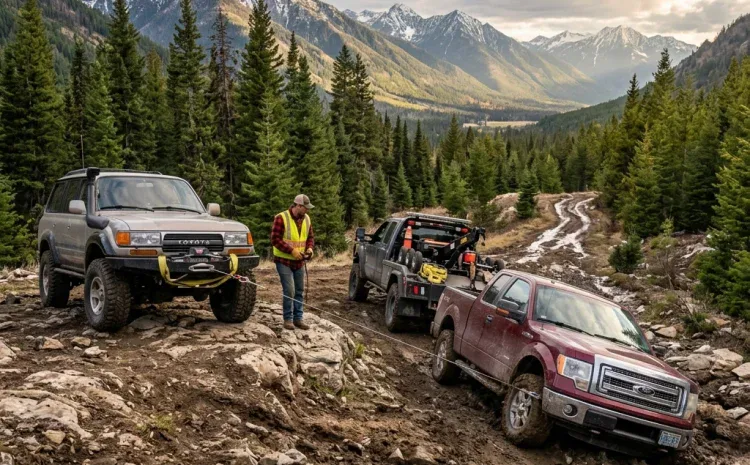
At Way Maker Offroad, we’ve seen it all. From simple winch-outs to complex multi-point extractions in sub-zero temperatures, we know what it takes to get you home. This guide covers everything you need to know about professional recovery services, essential gear, and why calling in the pros is often the smartest move you’ll make all day.
The Reality of Western Montana 4×4 Service
Western Montana offers some of the most diverse and punishing terrain in the lower 48. We deal with high-altitude snow that turns to ice, slick mountain clay, and river crossings that can change depth in hours. Standard towing companies usually won’t touch these spots, they don’t have the equipment, and frankly, they don’t want the risk.
That’s where specialized off-road recovery services come in. When you’re miles from the nearest paved road, you need a team that understands vehicle physics and has the gear to back it up. If your rig is suffering from more than just a bad line choice, you might also need to look into performance drivetrain upgrades to ensure your axles and lockers are up to the task next time.
Recovery Terminology: Speak the Language
Before we dive into the “how-to,” let’s get the terminology straight. If you’re talking to a recovery specialist on a satellite phone, using the right terms can save lives.
- Snatch Block: This is a heavy-duty pulley that allows you to change the direction of your winch cable or double your winch’s pulling capacity. By routing the line back to your vehicle, you create a mechanical advantage that makes a 10,000-lb winch pull like a 20,000-lb beast.
- Kinetic Rope: Unlike a static tow strap, a kinetic rope is designed to stretch. It stores energy like a rubber band and uses that momentum to “snatch” a stuck vehicle out of mud or snow. It’s smoother on the vehicles and far more effective in low-traction scenarios.
- Deadman Anchor: When there’s not a single larch or pine tree in sight, you have to make your own anchor. A deadman anchor involves burying a spare tire, a log, or a specialized earth anchor deep into the ground to provide a solid point to winch against.
Understanding these tools is the first step toward self-sufficiency. If you’re looking to build your own recovery kit, check out our selection of accessories and equipment to get geared up properly.
Why Professional Recovery (WAY-MORR) is Essential
DIY recoveries are great, until they aren’t. We’ve seen enthusiasts try to pull a truck out using a hardware-store chain, only to have it snap and fly through a windshield. Our specialized recovery arm, WAY-MORR, is built on three pillars: Safety, Integrity, and Capability.
1. Advanced Equipment
We don’t just use bigger winches. we use load-rated soft shackles, synthetic lines, and wireless controllers that allow us to stand clear of the “kill zone” while managing an extraction. We also utilize GPS mapping to find you in locations where “the big rock by the trail” isn’t a helpful description.
2. Vehicle Preservation
Amateur recoveries often result in bent tie rods or ripped-off bumper mounts. A professional knows exactly where to attach recovery points to distribute the load across the frame. If you’ve already had a rough outing, you might need electrical system repairs if your winch fried your harness during a DIY attempt.
3. Environmental Awareness
Montana is beautiful, and we want to keep it that way. Professional recovery involves minimizing “trail scarring.” We use tree trunk protectors and Tread Lightly principles to ensure the recovery process doesn’t destroy the very trails we love to ride.
Winter and Snow Recovery: A Different Beast
In Western Montana, winter recovery is a standard service. Snow is deceptive; it looks solid until it’s packed into your wheel wells and your tires are spinning on ice.
The biggest mistake in snow recovery is “digging in.” Once your tires spin and create heat, they melt the snow into a layer of ice. Suddenly, you have zero friction. We use specialized air-down techniques and high-floatation equipment to walk on top of the snow rather than plowing through it.
If you’re planning a winter expedition, make sure your rig is ready for the cold. Read our Western Montana 4×4 Survival Guide for tips on prepping your vehicle for the deep freeze.
The “Point of No Return”: When to Call for Help
There is a fine line between a “fun challenge” and a “dangerous situation.” If you find yourself in any of the following scenarios, stop what you are doing and call a professional:
- The Angle of Repose: If your vehicle is tilted at an angle where a roll-over is imminent if it shifts an inch.
- Water Ingress: If you are stuck in a creek or river and the water level is rising toward your air intake or electronics.
- Mechanical Failure: If you’ve snapped an axle or blown a differential while trying to get out. No amount of pulling will help if the wheels won’t turn. In this case, you’re looking at a diesel or gasoline service or even a full Cummins engine rebuild if you’ve hydrolocked the motor.
- Impending Darkness/Weather: Montana weather shifts in minutes. If the sun is going down and you don’t have the gear to spend the night, call for help while you still have a signal.
Off-Road Recovery Mistakes to Avoid
We see the same errors over and over. Avoid these to keep your recovery from turning into a disaster:
- Using a Tow Ball as a Recovery Point: Never do this. A tow ball is not designed for the sheer force of a snatch recovery. They can shear off and become a lethal projectile.
- Standing Near the Line: Always keep a “dampener” (like a heavy jacket or a specialized bag) over your winch line. If the line snaps, the dampener drops it to the ground rather than letting it whip.
- Overworking the Winch: Winches generate massive heat. If you’re doing a long pull, give the motor time to cool down. A burnt-out winch is just heavy jewelry on your front bumper.
Need to see what a proper setup looks like? Browse our gallery to see the rigs we build and the recoveries we’ve tackled.
About Way Maker Offroad
Located in the heart of the Bitterroot Valley, Way Maker Offroad is Western Montana’s premier destination for 4×4 performance, diesel engine expertise, and specialized recovery. With over 20 years of experience and ASE-certified technicians, we don’t just fix trucks: we build machines that conquer the backcountry. Whether you need a simple oil change or a full-blown custom build, we approach every job with the rugged integrity Montana demands.
Don’t Wait for the Mud to Dry
Preparation is the difference between a great story and a total disaster. If you’re planning on hitting the trails in Western Montana, make sure your rig is up to the task.
Schedule a Pre-Trail Inspection with Way Maker Offroad today. From winches to lockers, we’ll make sure you have the gear to get out of whatever the mountain throws at you. If you’re already stuck, give us a call: the WAY-MORR team is ready to head out.